In Canada, we are in the middle of Freedom to Read Week. Find out more on the Freedom to Read website. Let us know what you have been doing to recognize this week in the comments. The Freedom to Read kit is available for free download. It features an in-depth history of the censorship of comic books and many other interesting articles.
Don't forget to sign up for the Banned Book Challenge, running from now until June 30.
Showing posts with label resources. Show all posts
Showing posts with label resources. Show all posts
Thursday, February 25, 2010


Wednesday, January 20, 2010
Resources for Banned and Challenged Authors

Luminarium: Anthology of English Literature has a number of links to resources for contemporary writers whose works have been challenged.
Included are:
Toni Morrison
Margaret Atwood
Amy Tan
Alice Walker
Find out more about the Pelham Public Library's Banned Book Challenge and register today.
Thursday, July 30, 2009
Gearing Up for Banned Books Week
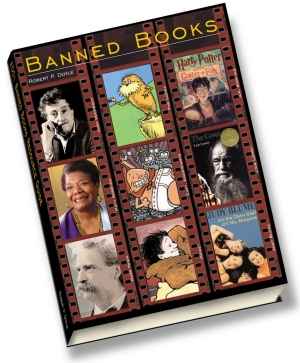
 As our neighbours to the south gear up for their Banned Books Week, I thought the following resources would come in handy for teachers and librarians looking for lists of challenged and banned books. These excellent yearly resources have been created by Robert P. Doyle who received the 2009 Freedom to Read Foundation Roll of Honor Award. The books are sponsored by American Booksellers Association, American Booksellers Foundation for Free Expression, American Library Association, American Society of Journalists and Authors, Association of American Publishers, National Association of College Stores and are endorsed by the Center for the Book in the Library of Congress.
* 2008-2009
* 2007-2008
* 2006-2007
* 2005-2006
* 2004-2005
* 2003-2004
The resource for 2009 includes a bibliography of books challenged, restricted, removed, or banned in 2008-2009 as reported in the Newsletter on Intellectual Freedom from May 2008 through May 2009.
Thursday, October 25, 2007
Great Censorship Site
Delete Censorship has a new look and some great new resources for anyone looking for information on banned books and other censorship issues. I personally like the moving book shelf. Click on an icon of a book and get the information on why it was challenged. Podcasts on issues around censorship are available for download.
The Constitution of the United States, Amendments to the U.S. Constitution, and Proclamation of Freedom to Read are available in PDF format. Although this site is sponsored by a book seller, the advertising is neither subliminal nor blatantly obvious.
The Constitution of the United States, Amendments to the U.S. Constitution, and Proclamation of Freedom to Read are available in PDF format.
 Although this site is sponsored by a book seller, the advertising is neither subliminal nor blatantly obvious.
Wednesday, October 03, 2007
Teaching Resource on Censorship
Don C. Barnett presents a teaching plan called Censorship: Drawing The Line. The page is hosted by the University of Saskatchewan College of Education and it appears to be at a high school level. It is of value since it covers Canadian issues.
The purpose of the lesson is: "To explore the issue of censorship through the values question: To what extent should society censor citizens' expression of thoughts?" Included are some great questions and activities for students, as well as suggested ways of evaluating. Unfortunately, a number of links such as the Canadian Censorship Time Line are outdated. Other than that, this is a great resource for Canadian Secondary School Teachers and it could be modified for younger students.
The purpose of the lesson is: "To explore the issue of censorship through the values question: To what extent should society censor citizens' expression of thoughts?" Included are some great questions and activities for students, as well as suggested ways of evaluating. Unfortunately, a number of links such as the Canadian Censorship Time Line are outdated. Other than that, this is a great resource for Canadian Secondary School Teachers and it could be modified for younger students.
Wednesday, November 08, 2006
Getting Graphic
 Like comic books which came before them, graphic novels are sometimes getting a bad rap. The dilemma is sometimes about where to catalogue them -- Juvenile, Young Adult, Adult? Some libraries, especially school libraries might be wondering if they should even have graphic novels in the collection.
For a history of the graphic novel, resources for choosing the right graphic novels for your collection, deciding how to catalogue and shelve them, and being prepared to deal with challenges, download this document prepared by The National Coalition Against Censorship (NCAC) or visit their website.
Monday, November 06, 2006
Norwegian Forum for Freedom of Expression
For a history of censorship and a searchable database of books that have been banned and challenged over the years, check out the Beacon for Freedom of Expression Project. Besides having a database of banned or challenged books, there is a second database of publications on censorship and the freedom of expression. There are a number of ways to search for data, such as according to author, title, country, time period.
This project has been produced by the Norwegian Forum for Freedom of Expression, the Norwegian National Library, and the Norwegian Library Association.
According to the site:
This project has been produced by the Norwegian Forum for Freedom of Expression, the Norwegian National Library, and the Norwegian Library Association.
According to the site:
Censorship has followed the free expressions of men and women like a shadow through history. In ancient societies, such as those of Israel or China, censorship was considered a legitimate instrument for regulating the moral and political life of the population. In China, the first censorship law was introduced in 300 AD. The origin of the term censor in English can be traced to the office of censor established in Rome in 443 BC. In Rome, as in the ancient Greek communities, the ideal of good governance included shaping the character of the people. Hence censorship would have been regarded as an honourable task. The most famous case of censorship in ancient times is that of Socrates, sentenced to drink poison in 399 BC for his corruption of youth and his acknowledgement of unorthodox divinities. But it is fair to assume that Socrates was not the first person to be severely punished for violating the moral and political code of his time. This ancient view of censorship, as a benevolent public service in the best interest of the people, is still upheld by countries such as China, as it was advocated by the rulers of the Soviet Union (USSR), responsible for the longest lasting and most extensive censorship of the 20th Century.
Thursday, May 25, 2006
Fahrenheit 451 Searchers and Lurkers
 OK. I have seen all of you out there looking for anything you can find on Fahrenheit 451 by Ray Bradbury. Curiosity? Essay due? Whatever the reason, I have placed additional links to good sites for information just for you. Why? I searched "Fahrenheit 451" "why banned" yesterday and found a ton of links that have dropped those very keywords into metatags to bring you to their sites which are selling things, getting you to sign up for things, etc. enticing you in with your request.
Check the links to the right under "Fahrenheit 451 Links" for lots of study guides, teacher resources, a site with the full text of the first chapter, and much more.
As for Fahrenheit 451 being banned, I cannot find an example of a full banning. It was butchered by publishers and some schools had teachers black out the swear words.
In 100 Banned Books: Censorship Histories of World Literature, Nicholas Karolides, Margaret Bald, and Sawn B. Sova explain that author Ray Bradbury learned that Ballentine books, his publisher had been censoring and removing sections from his Fahrenheit 451 for years without his permission. 75 passages were "edited" in order to eliminate words like "damn," "hell," and "abortion."
Can you say, "Irony?"
Subscribe to:
Posts (Atom)