FT Tech Hub reports on the visit Mark Zuckerberg, creator of Facebook, made to China. Zuckerberg, who founded the social networking site along with fellow students while at Harvard University, was named Time Magazine's "Person of the Year" for 2010. He is known for working long hours and FT Tech Hub speculates that Zuckerberg was more than just holidaying in China, where Facebook has been banned.
He was seen rubbing shoulders with the chief executive of Robin Li, Baidu's CEO and one of China's wealthiest men. Baidu is the Google of China, being their largest search engine. At the Cannes Lion advertising festival last summer, Zuckerberg stated that China was a key target for Facebook's growth. The article speculates that creating a local partnership could be the first step in having China allow Facebook to be established.
What will be interesting is to see if Facebook can be any more successful at avoiding government-sponsored censorship on its site and breaking through the "great firewall of China."
Map created by Facebook intern Paul Butler using data on its members. It provides a visual of where people live relative to their Facebook friends and where there are obvious gaps. The most obvious gap is China, where Facebook is banned.
This blog is now archived. A discussion on censorship through the Pelham Public Library, Fonthill, Ontario. Take the "Banned Book Challenge." A comprehensive list of "banned book" sites and resources for the novel "Fahrenheit 451" by Ray Bradbury can be found on the sidebar.
Showing posts with label China. Show all posts
Monday, January 03, 2011
Wednesday, March 24, 2010
China Google War
The Official Google Blog has an update on Google's approach to the cyber attack Google exposed. The announcement made by Google on January 12, 2010 to stop censoring search results has been covered in a previous blog entry. Follow-up entries can be found here and here.
On March 22, 2010, Google stopped censoring search results in mainland China. Searches conducted through Google.cn are being redirected to Hong Kong servers which will deliver uncensored results. According to the Google blog, "the Chinese government has been crystal clear throughout our discussions that self-censorship is a non-negotiable legal requirement." Google believes they have found a legal solution but one that is precarious since China could decide to block access to Google at any time. Google has created a web site to report daily on which Google services are available in China.
Sify News reports that AP reporters have been testing different search words and findings vary widely.
Thenextweb.com describes Google's move to use Hong Kong servers as a "subversive move" which may be damaging to the company. China has reacted to Google's move by blasting it through the state-run People's Daily. The Chinese government stated that Google's
Meanwhile, support for Google continues to be shown through the numbers of Chinese people leaving flowers on the sign outside of Google China's headquarters.
For Chad Catacchio’s take on the situation, check out the video.
You have the freedom to read, so take the Banned Book Challenge. Register the number of books you have set for your goal between now and June 30 on the online form. I will publish any reviews that are sent in the near future.
On March 22, 2010, Google stopped censoring search results in mainland China. Searches conducted through Google.cn are being redirected to Hong Kong servers which will deliver uncensored results. According to the Google blog, "the Chinese government has been crystal clear throughout our discussions that self-censorship is a non-negotiable legal requirement." Google believes they have found a legal solution but one that is precarious since China could decide to block access to Google at any time. Google has created a web site to report daily on which Google services are available in China.
Sify News reports that AP reporters have been testing different search words and findings vary widely.
Thenextweb.com describes Google's move to use Hong Kong servers as a "subversive move" which may be damaging to the company. China has reacted to Google's move by blasting it through the state-run People's Daily. The Chinese government stated that Google's
...collusion with the U.S. intelligence and security agencies is well-known…All this makes one wonder. Thinking about the United States’ big efforts in recent years to engage in Internet war, perhaps this could be an exploratory pre-dawn battle.
Meanwhile, support for Google continues to be shown through the numbers of Chinese people leaving flowers on the sign outside of Google China's headquarters.
For Chad Catacchio’s take on the situation, check out the video.
You have the freedom to read, so take the Banned Book Challenge. Register the number of books you have set for your goal between now and June 30 on the online form. I will publish any reviews that are sent in the near future.
Monday, January 25, 2010
China Denies Involvement in Attacks on Google
China has finally spoken out regarding the cyber attacks alleged to have originated in China, the BBC reported yesterday. China denies state involvement. An unnamed spokesperson from the Ministry of Industry and Information Technology in China stated, "The accusation that the Chinese government participated in [any] cyber attack, either in an explicit or inexplicit way, is groundless." He added, "China's policy on internet safety is transparent and consistent."
The US is being accused of hypocrisy since China believes "certain government agencies" illegally checked a massive number of personal e-mail accounts.

Cox and Forkum Political Cartoon
The US is being accused of hypocrisy since China believes "certain government agencies" illegally checked a massive number of personal e-mail accounts.

Cox and Forkum Political Cartoon
Friday, January 22, 2010
Google China Saga Continues
Illustration Bezinga.comGoogle CEO Eric Schmidt remains committed to stay in China, according to statements made yesterday. As reported in a previous post, there was a "highly sophisticated and targeted attack" on a number of high profile computer companies in China and Google threatened to pull out of China unless it could provide uncensored results. According to today's Telegraph, Schmidt has confirmed that that Google and China have been "in conversation." Schmidt added that they wish to remain in China but that they would like to be there "on somewhat different terms" than they have in the past. Although Google has continued to censor searches according to Chinese law, sources within Google said there are no plans to revoke their earlier stand on censorship. Stated Schmitd, "We continue to follow their laws, we continue to offer censored results. But in a reasonably short time from now we will be making some changes there."
PC World offers a timeline of the Google/China incident.
The Financial Post reports that Microsoft has released a patch for Explorer to secure the breach through which someone was able to target Google and other companies. Instead of releasing it on Tuesdays, as they have done with other patches, this patch was made available as soon as it was ready.
As expected, Google's presence in China and their threat to pull out continues to be addressed in the political arena. Secretary of State Hillary Rodham Clinton made unrestricted Internet access a top foreign-policy priority and urged China to investigate cyber intrusions that led Google Inc. to threaten to pull out of that country, the Wall Street Journal reports which also reported on China's reaction to Clinton's statements.
It will be interesting to see how all of this unfolds.
Tuesday, January 12, 2010
Google No Longer Willing to Filter in China
Photo: China HushGoogle's official blog reports that a "highly sophisticated and targeted attack" on Google's infrastructure has the company rethinking its involvement in China. Google faced criticism from a number of human rights organization for moving into China and agreeing to self censor. Read more in a previous post -- Google Censors Itself for China.
In Google's very candid post, David Drummond, SVP, Corporate Development and Chief Legal Officer, explains that what appeared to be a security incident, now appears to be a widespread attack on a number of large companies, the goal of which appears to be to access information on Chinese human rights activists. Google believes someone has tried to access the Gmail accounts of activists but has been successful only in getting to the subject headings of the email, not to content. They believe that the accounts were not accessed through a breach in Googles' security but through phishing scams or malware that has been placed on users' computers.
Google is working with the appropriate U.S. authorities and has reported the breaches to the other large corporations.
States Drummond,
We have taken the unusual step of sharing information about these attacks with a broad audience not just because of the security and human rights implications of what we have unearthed, but also because this information goes to the heart of a much bigger global debate about freedom of speech.
Although they believe China has benefited from the launch of Google.cn in January 2006, they are following up on their promise to carefully monitor conditions in China.
These attacks and the surveillance they have uncovered--combined with the attempts over the past year to further limit free speech on the web--have led us to conclude that we should review the feasibility of our business operations in China. We have decided we are no longer willing to continue censoring our results on Google.cn, and so over the next few weeks we will be discussing with the Chinese government the basis on which we could operate an unfiltered search engine within the law, if at all. We recognize that this may well mean having to shut down Google.cn, and potentially our offices in China.
This could have far-reaching consequences for China and for free speech and perhaps even Chinese - Western relationships.
Don't forget that the Banned Book Challenge begins in February.
Wednesday, December 23, 2009
Terminal Man
Like something out of The Terminal (which was also based on a true story), Feng Zhenghu is a man stuck in Tokyo’s Narita International Airport, likely because of a book he authored that criticized Chinese regulations against foreign company investment. In 2000, the author was sentenced to three years in a Chinese prison. He was also critical of the government's handling of the Tiananmen Square demonstration.
According to the Boston Globe, Feng sits on a bench in front of the Japanese customs booth, refusing to pass through customs because that would mean entering Japan. He has been turned away by Chinese officals eight times. Four of the eight times, he made it as far as Shanghai’s Pudong International Airport before being sent back to Tokyo.
Feng has had no access to food courts or hot showers but lately, with the help of Global Voices Online which publishes selected updates of the situation, he has been able to communicate with the global community through his phone and says that he has obtained enough food for the next month.
Some people say that I am battling for citizen's right to return back to China by myself, but I know that many Chinese people are behind me. When I was hungry and desperate, many Chinese from mainland China, Hong Kong and overseas delivered food to me. When I was cut from internet connection, some Internet experts from mainland China gave me technical support and help me to build a twitter account. Now I can use my mobile phone to update my status and let people from mainland China to know what's going on here.
A Music Video entitled Let Feng Zhenghu Return Home has been posted on YouTube.
Thursday, August 28, 2008
Jingjing and Chacha, China's Censors
Canadian Joann Dionne, has written an interesting book that chronicles her year as a teacher in China. She gives some insight into the everyday life of China in Little Emperors: A Year with the Future of China. In the Epilogue, she includes information on the Chinese authorities and censorship, stating that there are over thirty thousand cyber cops monitoring the 162 million Internet users.
She talks about the Internet avatars which pop up on computer screens to remind users that they are being watched.Chinese cyber police also get help from their Internet avatars, the wide-eyed manga-esque cartoons Jingjing and Chacha. Jingjing is a boy police officer. Chacha is a girl. Their names come from the Mandarin work jingcha or police in English....Beneath the big, watchful eyes of Jingjing and Chacha, Chinese Internet users must be careful not to type "remember Tiananmen [sic] Square," "free Tibet," or "Falun Gong forever" in their emails, or criticize anything bigger than Starbucks on their blogs. If they do, the real jingcha just might come knocking at their door. Jingjing and Chacha encourage people using the Internet in China to censor themselves, saving those thirty thousand cyber cobs a whole lot of work.Wikipedia includes an entry and China Digital Times has an entry blog from the day the characters first appeared in the main portals of Shenzhen city, Guangdong.

Speaking of China, the Foreign Correspondents Club of China has published a list of incidents of interference from Chinese authorities. While this list covers the last few years, it is interesting to see how freedom of information has been curtailed during the Olympics, in particular.
Saturday, April 26, 2008
Words Without Borders Literary Tour
(Graphic VU Weekly)Edmonton's Vue Weekly recently featured an article entitled Writers Without Borders which highlights speakers who were recently on tour with PEN Canada’s Words Without Borders: a literary tour for freedom of expression.
Rita Espeschit, a children's author originally from Brazil, explains that Canada is not exempt from censorship on a couple of levels.
The challenged books that you see here are usually children’s books. All those Christian parents who don’t like something want [books about that subject] banned from schools. In the area of writing for children, there’s almost an institutionalised self-censorship that happens, not just on the level of writing but at the editing level, too. Publishers are very sensitive about anything people would get angry about in a book. [This anger] is too carefully avoided; there’s a sterilized universe to the books that’s not real life.
While Canada is not exempt from censorship, authors do not experience the kinds of consequences that authors in repressive countries experience. Jalal Barazanji, a poet and journalist from Iraq spent three years in jail for his writing. Now living in Canada, he has taken a position in Edmonton as their first “writer-in-exile.”
Other authors on the tour include: David Albahari, a writer and translator from Serbia and Sheng Xue, of China who moved to Canada soon after the June 4th Tiananmen Square massacre in 1989.
Don't forget to check out the Pelham Public Library's "Banned Book Challenge."
Saturday, December 22, 2007
PEN Mightier Than the Sword in China?
According to the Agence France-Presse, a global news agency, Chinese police have tried to disrupt an awards ceremony organized by PEN, an International Agency that advocates freedom of expression. Two writers have been detained by police as the Chinese government moves to keep control of dissent as the 2008 Beijing Olympics approach. According to a press release from PEN Canada, there are now 41 Chinese writers who have been wrongly imprisoned. Li Jianhong, who was due to receive an award at the ceremony, is under house arrest. Liao Yiwu, who was to receive the Freedom to Write Award, was detained and was scheduled to be returned to his home. Many of the 40 people who had been invited to the ceremony received warnings from police not to attend.
Visit PEN Canada's Web Site for more information on PEN's campaign and other censorship issues.
In an unrelated story, the Washington Post highlights the story of Chen Yuhua, a Chinese resident who is suing the Beijing Municiple government over the removal of his Internet post about dogs. He has been careful to follow procedure exactly. His is a bold challenge to the atmosphere of the control of information. His post was an attack on regulations barring any dog over 14 inches high and restricting each family to only one dog. This is only the second time someone has gone to court to sue over censorship.It is believed that more than 30,000 censors monitor the Internet using technology to block sensitive sites. A list of keywords used to filter Internet content in China was obtained by the Washington Post back in 2005. Of the 236 words, 18 are obscenities. The rest are related to politics or current affairs.
Sunday, November 26, 2006
Change of Heart?
It was reported in a recent post that China had begun to allow Wikipedia through the "great firewall of China." It is not clear whether there has been a change of heart or whether there are technical difficulties but a CNN story now reports that barely a week after it was allowed access, China no longer had access to Wikipedia.
A Wikipedia article reports November 17, 2006 as the date on which access was again cut off.
Monday, November 13, 2006
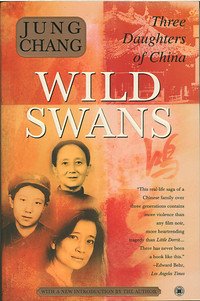
Wild Swans Discussion Questions
The Pelham Public Library's Book Club just finished reading this fascinating book. I understand from the author's foreward that although the book is technically banned in China, it is widely available, as are many other banned materials.
I have noticed a number of people looking for discussion questions either for a book club or class. The top questions are ones I made up. The other questions can be found in the back of the book or on Simon and Schuster's web site.
I hope this meets a need.
Wild Swan Discussion Questions
Monday, October 23, 2006
China Sees Value in Wikipedia

According to author Cory Doctorow in a post at Boing Boing, Wikipedia, the encyclopedia that can be edited by anyone has been unblocked in China. Unlike Google, Microsoft and Yahoo, Wikipedia refused to censor itself for use in China. It seems that China has seen more value than potential harm in allowing it to be unblocked. However, readers in China report problems getting to the Chinese language version and into articles on certain subjects.
Says, Doctorow:
That's predictable enough -- but it means that Beijing is now stuck playing cat-and-mouse with Wikipedia, having to ferret out every potentially sensitive page and update its filters accordingly. If MSFT, Yahoo and Google followed Wikipedia's lead, we could force Beijing to devote ever-escalating resources to this effort, a denial-of-service attack on its censors.
Thursday, August 10, 2006
Wild Swans and Chairman Mao

I recently finished reading Wild Swans by Jung Chang. This memoir has been banned in China since 1994 and apparently even pirated versions omit references to Mao.
Chang looks back over three generations of women in her family and the upheaval in their lives as they endured the Japanese occupation; the Civil War; Mao's rise to power; and the Cultural Revolution. It is a fascinating look at history and its effect on one family. From her grandmother, whose bound feet were an outward sign of her lack of freedom as a concubine to a powerful man, to Chang herself, who worked towards Mao's goals with a passion, the book describes the turmoil the Chinese have endured. It also is a tribute to their strength of character. It sold more than 10 million copies and was translated into 30 languages.
Chang has just published a controversial biography of Mao which is banned in China, but she hopes the first Chinese translation will break through. The book took 12 years to complete.
Ironically, the book 1984 made her wonder, "in a naive way, if Orwell had ever been in China. I was reading about the society I'd been living in. How did he know?"
Wednesday, August 09, 2006
You Have to Find out Somehow
According to an article by Reuters, a clinic in China posted an erotic book online despite China's tight rein on anything it considers pornographic or even erotic.
Suprisingly, the sexual health clinic defended its posting. The posting was of excerpts of an ancient, erotic novel called "Secret Lust of Spring Palace" that contains explicit sexual content.
The health clinic defended its actions, saying it was intended for treatment, not for personal gratification. Dr. Zong, a spokesperson for the clinic, said the hospital specializes in tackling sexual problems, both physical and mental, that lead to infertility. He believes this kind of literature can be used to help educate and cited the example of a couple who had complained about infertility. It turned out they did not know how to have sex and that the wife was still a virgin when they came to the hospital. Thus the need for explicit material.
Despite pornographic literature being banned, sexually explicit content is widely available online and on street corners in China.
Suprisingly, the sexual health clinic defended its posting. The posting was of excerpts of an ancient, erotic novel called "Secret Lust of Spring Palace" that contains explicit sexual content.
The health clinic defended its actions, saying it was intended for treatment, not for personal gratification. Dr. Zong, a spokesperson for the clinic, said the hospital specializes in tackling sexual problems, both physical and mental, that lead to infertility. He believes this kind of literature can be used to help educate and cited the example of a couple who had complained about infertility. It turned out they did not know how to have sex and that the wife was still a virgin when they came to the hospital. Thus the need for explicit material.
Despite pornographic literature being banned, sexually explicit content is widely available online and on street corners in China.
Subscribe to:
Posts (Atom)